February 21, 2026
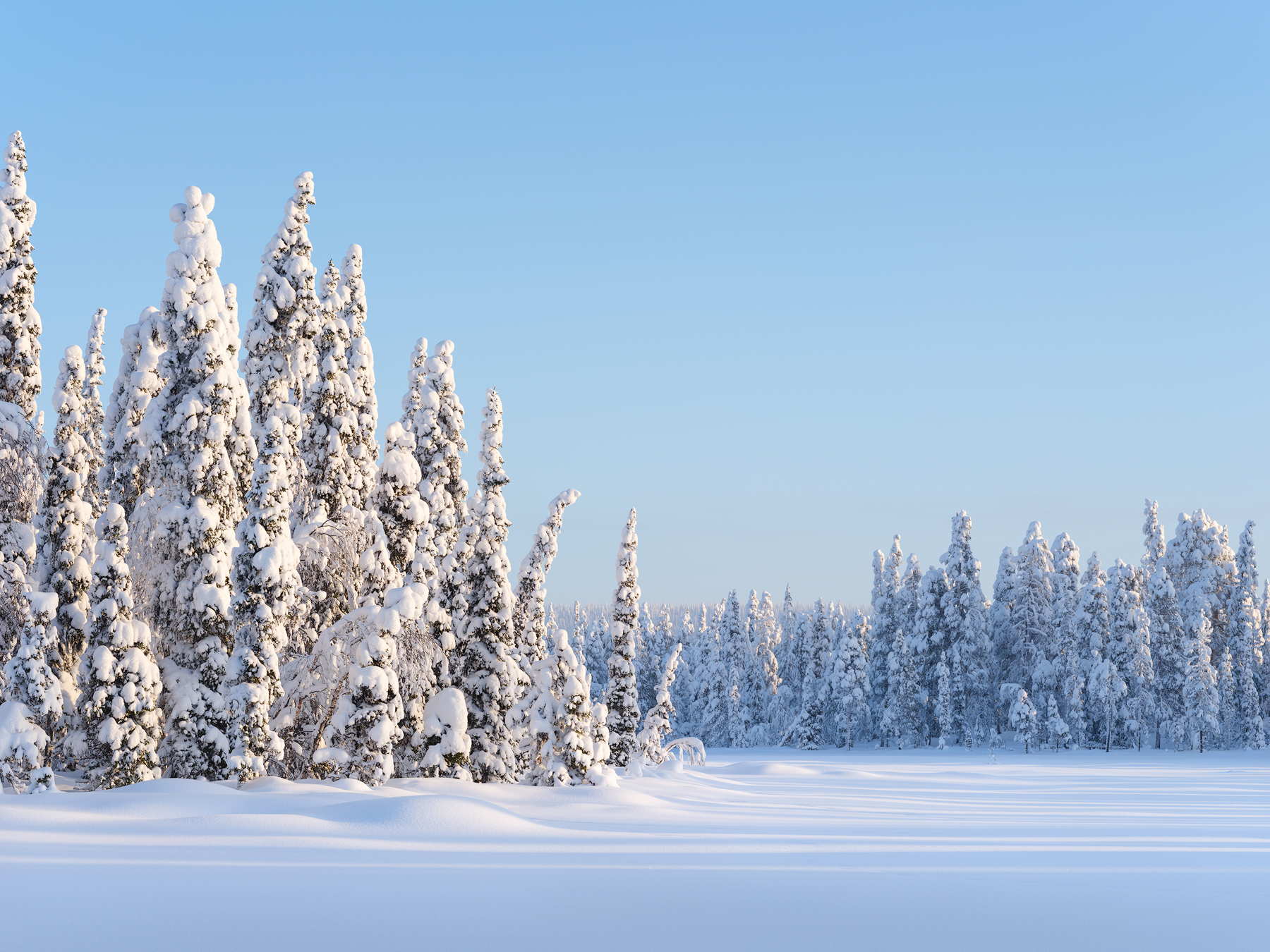
The weather clears in the morning after a night of snowfall. I ski over the marshland to the grove of spruce trees, as I have countless times this winter. Light filters through the treetops, casting long shadows across the landscape. There’s a quiet, pristine magic to the scene — the trees, coated in fresh snow, seem to glow in the morning light. The very last of midwinter lies before me. I make a photograph, hoping to hold the moment.
I turn my face toward the sun. A gentle warmth touches my skin. I’m back in Muddus for the fourth time since snow first covered the land last autumn. After months of cold and darkness, the sun has returned to the boreal forest.
The light falls across the landscape differently now than in midwinter. Shadows deepen, and the sun grows stronger, carrying the promise of spring far on the horizon.
By midday, the south-facing sides of the trees thaw in the sunlight, while the shaded north sides remain covered in rime and snow. Looking south, the forest still resembles midwinter, but turning north, I sense the seasons turning.
Each tree is like a mountain, with a sunlit south face and a shaded north face. In Sámi, the north side of a hill or mountain is called Irkká* — snow conditions there are often looser and deeper, providing better grazing for the reindeer. Shielded from the sun, the snow lingers longer into spring in Irkká.
I wait through dusk for the owl-light to settle. I tune in, listening to the land. It becomes a kind of meditation, where no thoughts have room to form.
But I hear nothing.
Owl-light, but no sign. Somewhere in the forest, the hawk owl waits, silent.
* I first encountered the Sámi word Irkká in Yngve Ryd’s Snö (2001)
~February 22, 2026
I ski toward the small forest mountain. Along a path I know well by now, I pass the grove of spruce trees and the old pine where a black woodpecker has carved out a hole. I ski over the ridge, past the two aspens, and onto a clearing at the foot of the mountain. I stop and rest.
In a few months, spring awaits. With each day, life becomes easier for the inhabitants of the taiga. I feel a quiet sadness in leaving midwinter with its soft light and short days. But ahead lies another beautiful season, when life slowly returns to the forest.
Snow falls from a nearby spruce, then from a pine. The warmth of the sun makes the snow heavier, and in the end, gravity works its wonders. One by one, the trees around me shed their winter coats. Over the course of a few hours, almost all of them are bare, and the landscape changes character.
It is magical to witness this transformation, one tree at a time. The Altai spruce are the most spectacular, their lean, highly adapted structure releasing the snow all at once like an avalanche. Colors I haven’t seen since October return in the crisp sunlight: the vivid green of the needles, the earthy tones of the trunks.
A new season is here, whether I am ready or not.
(For the best experience, headphones are recommended.)
February 24, 2026
I wake up to a cold morning. -32°C.
Back to midwinter.
I do as the birds do: I dress in feathers.
Down jacket and down trousers.
Grateful for the warmth they bring.
February 27, 2026
The snowfall that came overnight eases in the morning, and a blue sky reveals itself above the camp. I head out on my skis into what now feels like home.
The opening closes again, and the light turns pale grey. I leave my backpack behind and ski without it — what a difference, a sudden sense of freedom.
I come across a hole made by a black woodpecker in an old pine. The tree is still alive, seemingly thriving despite its wound. It feels good to witness how it bears the woodpecker’s damage — with grace.
Something in me gives way, and the events of the past days, the hopes and longings closest to my heart, rise to the surface. I kneel in the snow and shed a few tears. The tree’s presence and resilience comfort me, offering perspective.
The hole carved by the black woodpecker has become a possible nest for other birds, such as the hawk owl. The pine gives home to the woodpecker, and the woodpecker, in turn, provides a home for the owl.
~March 1, 2026
The three-toed woodpecker uses dead, standing pine trees as their instrument, drumming to mark their territory. This morning they are joined by the song of the willow tit, creating a kind of stripped-down forest music — a taste of the full orchestra that will arrive later in spring. I couldn’t ask for a better way to celebrate the arrival of March.
Later in the day, I sit in the entrance of my tent enjoying a cup of coffee when a three-toed woodpecker lands on a small spruce some twenty meters away. He starts to peel off the bark in search of food. Fascinating to watch, I study his behavior and the way he interacts with his environment. After a while, a willow tit arrives, following the woodpecker, also hoping for a meal.
Through my work on this project, I’ve come to feel a deepening empathy for the land and its inhabitants, seeing the forest through the eyes of those who live here:
The three-toed woodpecker’s forest.
The willow tit’s forest.
The hawk owl’s forest.
March 4, 2026
At sunset, I ski to a small lake to listen for the Idjalodde — Sámi for night birds, the owls. At this time of year, the males call to attract a mate. I dig a hole in the snow for my legs and settle onto my skis. I’m tempted to light a small fire, but choose not to. I don’t want to disturb the silence. I sit for hours, watching the last of the daylight fade as the starry sky above grows more intense. I listen closely, but there is nothing — only silence.
A little disappointed, I ski back to the tent. Emerging into a small clearing, I see the full moon rise above the treetops, casting long shadows across the landscape. I stop to take the scene in. Then I hear it — a familiar, haunting sound. The hawk owl calls into the night, hidden in the grove of spruce trees that shelter my tent, as if calling to me.
After a few minutes, the hawk owl’s call fades. All that remains is the whisper of the northwesterly wind through the trees.


