November 22, 2025
I ski through a light snowfall. I’m on my way to Muddus National Park and toward one of the small cabins out here. I’m going to spend some time in this quiet area, in this quiet season, just as midwinter is about to arrive in the taiga.
I ski first along a forest road, then across marshland, and the last stretch through old pine forest. There are 20 cm of powder snow without any supporting layers — barely enough to ski on. My heavy backpack weighs me down, at times turning the skiing into a balancing act. I have to move with care in the forest, and for the final kilometers I take off the skis and pull them behind me. Too many rocks hide beneath the snow. They will not be gentle on my wooden skis.
Tired, I finally reach the cabin. Because of the recent cold, the temperature inside is lower than outside. I get the wood stove going. A highlight of the day. A highlight in life. There is hardly a more pleasant sound or a more pleasant warmth than that of a wood stove. And the cold and the damp clothes soon become a distant memory.
I head out and gather snow in a large pot and place it on the stove. Soon dinner and evening tea are ready. “Welcome to the table,” I say to myself.
~November 24, 2025
I wake up early, make a fire in the stove, and have a quick breakfast before heading out. It’s still dark as I walk through the forest, dragging my skis behind me. When I reach the marshland, I can finally begin to ski. There are no rocks hiding beneath the snow here. It is –10 degrees Celsius, overcast above me but clear in the west. I follow my track from the day before — it’s always a good feeling to follow your own path. The sky clears. In the north, it turns pink. The temperature drops.
The sun rises, and even if it does not offer much warmth this time of year, it does wonders for my soul. I ski around, exploring the marshland and the small forested islands. I feel the cold air against my face. I look at the thermometer, it’s now –22.
There is something very special about moving silently through the taiga on wooden skis. It’s a sensual experience. My three-meter-long skis, made from birch in old Sámi tradition, travel gently through the landscape. It’s a time machine: skis like these have carried people through the taiga for over 5,000 years.
I enjoy the few hours of sunlight; in just a couple of weeks the sun will no longer appear above the horizon. The dark season will begin.
The sun sets just after 1:30 PM, and I begin making my way back. I ski across the snow-covered marsh when ice suddenly forms beneath my skis. Without noticing, I’ve skied over ground that isn’t fully frozen. I remove the skis and carefully clear the ice beneath them. After some effort, I continue my journey, although a little slower than before. I return to the cabin just as darkness settles in.
~
November 25, 2025
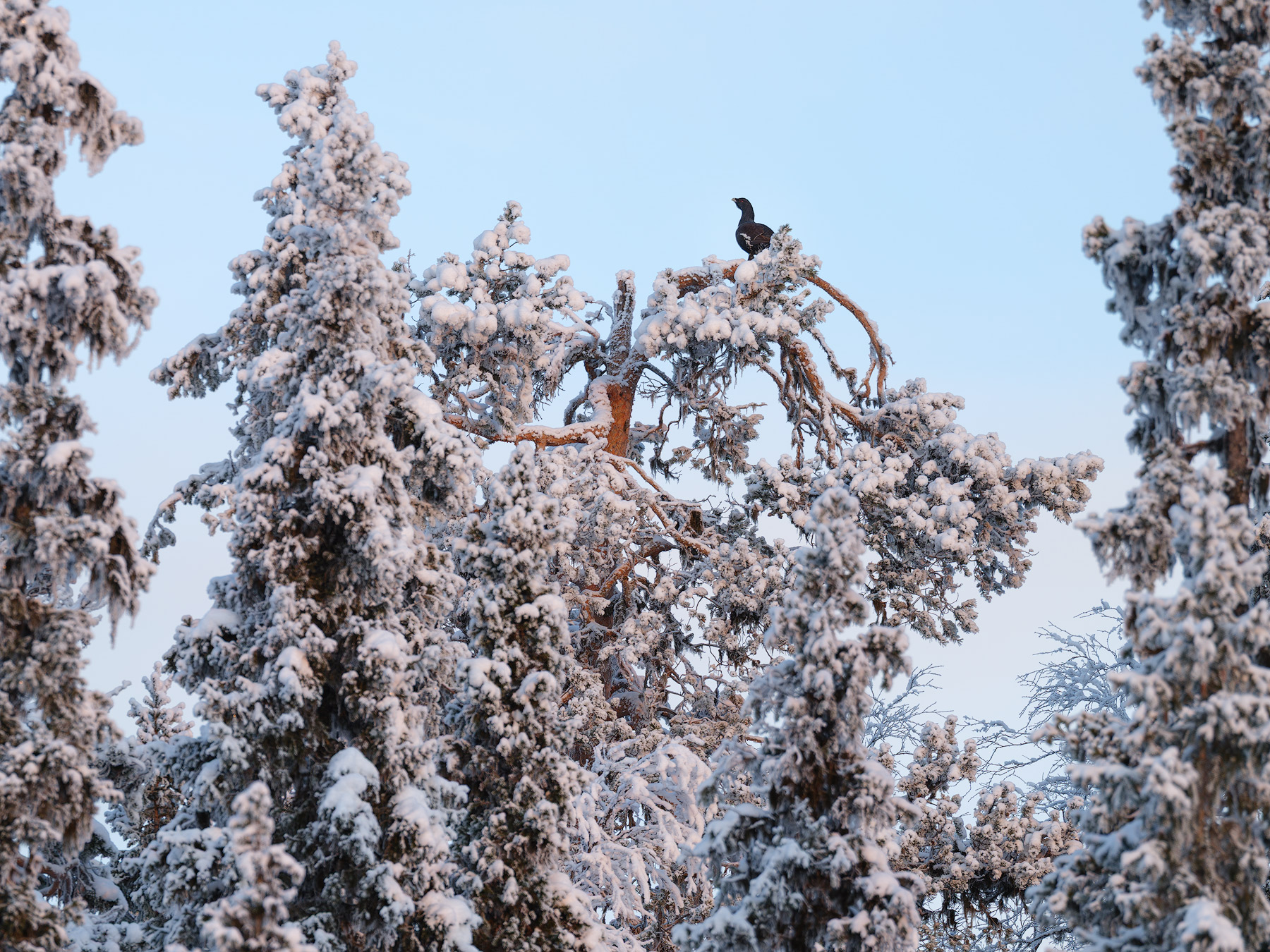
I make my way further out across the marsh, which stretches toward the horizon like an ocean*. In the middle of this ocean, perched in an old pine on a small island of trees, a capercaillie (Tjäder) sits quietly. I am allowed to bring out my camera and enjoy its company through the viewfinder.
A Siberian jay (Lavskrika) lands in a small spruce behind me. There I stand, in complete silence, with two of the taiga’s most characteristic inhabitants, both of which spend the winter here, enduring the harsh conditions. The cold weighs on all of us. I begin to shiver. In midwinter, life exists on the edge. Each of us must conserve energy to survive.
Beyond midwinter, another spring awaits. But that is still far away — for my brave friends, and for me.
* The Sámi word for marsh is áahpe, which also means ocean.


